Wednesday, June 8, 2016

Kasuri Foundation Course- Days 6, 7 and 8


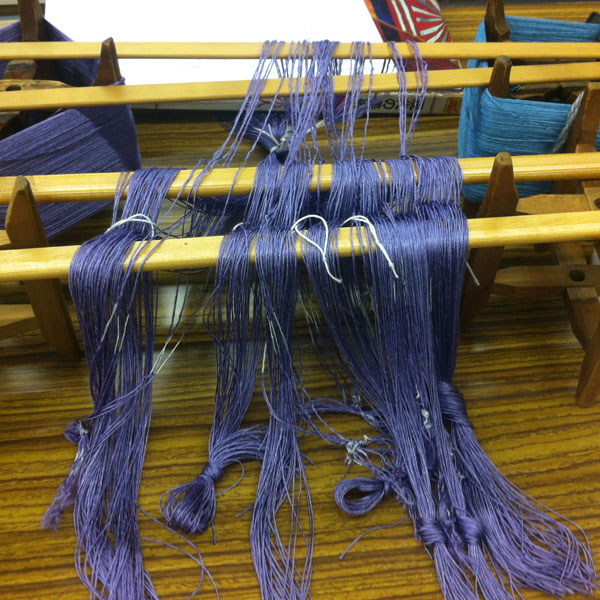
With the new week came the start of a new Kasuri project. This time we are making a cushion. I chose the pattern you see in the second last image. It is not very clear from the photo but there are 2 different colours, one for the warp and another for the weft, meaning the Kasuri had to be bound and be dyed with two different colours. 

This time instead of ramie we are using silk which is particularly difficult to work with because it gets caught just about everywhere and tends to fray quite easily. I decided I wanted to dye my warp with a greyish green, inspired by the bamboo forest I had seen last week. But something was very wrong in the swatch I used as reference and instead of green I ended up with a weird blue. And my lilac did not really end up that well either and in the end I was left with 2 colours that do not really speak to me. This is not problematic considering the objective is to learn Kasuri.

The third photo shows a goko swift. It is a Japanese swift and it has a wonderfully simple design. We use it to wind skeins onto the kiwaku. The kiwaku are also japanese and used to wind the yarn onto instead of simply making it into a ball. They come in very handy during the whole weaving process but seem to work best with finer yarns.

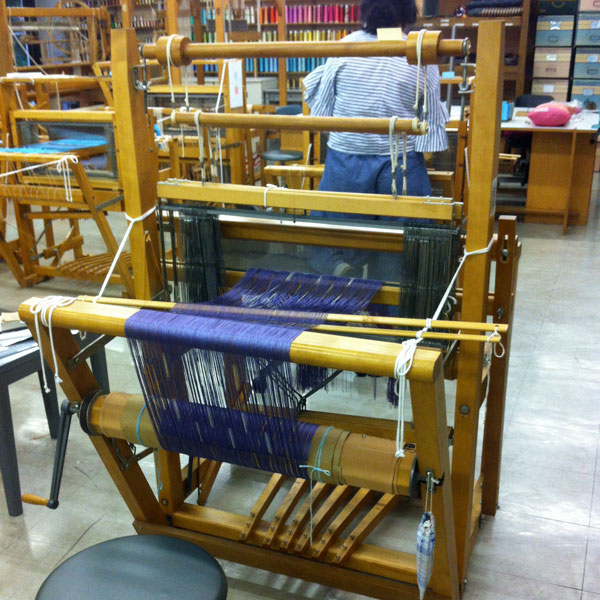
Setting up this loom was much more complex for this project because of the scattered kasuri. It took 2 days to set the loom, from pre- sleying the reed to adjusting the final tension. It was 2 very tiring days of doing and undoing, fixing one thing and making another worse. Kasuri is proving to be a true test of patience and incredibly strange how we have to be so exact to the millimeter to achieve something we know will inevitably be crooked. When I asked Emma sensei, "There must be an easier way. Is there a secret? Because it all feels so incredibly precise and so abstract at the same time. Why try and adjust the tension by feel alone when you can adjust it when you have already started weaving and know it is not right?". Emma sensei replied, "I have no secrets. It must be cultural. We try and do everything as perfect as we can now so that we don´t have to fix things later." This is a true test. It can never be perfect, but we have to try. It seems impossible. But at the end of the day I did see some improvement, I am just waiting for the click and to find the balance between culture and a perfectionist sensei. Perhaps I need to revisit Mount Kurama, a Temple nearby that is supposed to be "Kyoto´s number one power spot". I need to recharge.

This week also marked the arrival of my indigo seeds. The Tokushima Prefectural Josei Senior High School have dedicated themselves to the indigo cycle, from seed to dye. They are also very generous and mail out seeds to anyone interested, all they charge is postage, which must have been about 20 yen cents. Each packet has enough seed for about 100 meters squared. Next Spring, back home, should the climate agree, I will start a small plantation of Japanese Polygonaceae, to add to my seeds for colour garden that had to stay on standby due to this trip.

Thursday, June 2, 2016

Kasuri Foundation Course- Days 3 and 4


Things move very fast here at the Kawashima Shuttle club and by the end of today, day 4, we had completed our first Kasuri project. Tomorrow we begin preparing a new warp for our second and final foundation work. Day 3 saw us set up the loom and begin weaving and today it was all over. As simple as that. Kasuri really is a very precise art as can be seen from my samples (or not). The shifting is normal and allowed but there are limits and I found myself unweaving several sections at a time to correct a millimeter "mistake". The samples above show warp and double Kasuri and the last example was just a free do whatever you like.

As a reward for working so hard after school we went for a bike ride to "The bakery". It was well worth it. It is a "French" inspired bakery, meaning there was actually stuff there I could recognise, like croissants, bread, cheese sticks etc. In the end I bought a bag full of stuff the strangest of which was a bamboo charcoal bread stick, which was delicious.

On the way back we came across a bamboo forest to keep to the theme and more of the neat and quirky Japan we have come to expect. My favourite are the warning signs normally place by the side of the road where there might be a drain cover for example. 

And I keep on confirming my theory that dogs in Japan even though may go to salons and hotels do not bark. Not a single dog I have seen has barked, unless for maybe one and it was at another dog which is perfectly reasonable. No dogs barking at night, no dogs barking at strangers. No barks.


Tuesday, May 31, 2016

Kasuri Foundation Course- Days 1 and 2


And so begins Kasuri, the real reason why I ended up in Japan. Kasuri is a resist dye technique, where threads are bundled, masked, dyed and when woven create wonderful patterns. There are three types of basic patterns you can achieve: warp, weft or warp and weft(double Kasuri). There are still some more techniques to create patterns by dyeing the warp directly on the loom, shifting Kasuri and others we may not have time to learn.

We started with an 80gram skein of ramie yarn. Ramie comes from the nettle family and is very commonly used in Japan, being similar to linen in it´s lightweight and fresh properties, and absorbs moisture quite well. Everything about Kasuri has to be very precise as seems everything in Japan. Measurements are to the millimeter or things just don´t add up, because mistake on top of mistake makes a big difference at the end of the day in Kasuri.

The first day involved lots of measurements, winding the warp and weft and tying the Kasuri pattern for both, leaving them ready for day 2 which was today when the yarn was dyed in a colour of our choice. The end result will be a set of coasters that show the various basic types of kasuri and seen above in the green samples. 

Working in the dye room was very exciting, but it all happened a little fast and if it wasn´t for the help our expert teachers it would not have gone so smoothly. In the end presented with hundreds of colours to choose from I chose a reddish orange that I named "Temple Orange" after the many temples and shrines I have seen painted a similar colour.

When it was finally time to remove the kasuri binding we were all relieved to see the supposed white we had started with. And as soon as it was all dry it was off to pre sleying the reed. This means that tomorrow we finish setting up the loom and with a little luck start weaving.

If you ask me, there seems to be a little monkey magic going on here.


Sunday, May 29, 2016

Surrounds: Part 1.


Kawashima Textile School is located in a small town near Ichihara train station, in the Sakyo Ward of Kyoto. It is a quiet town, already considered countryside, with a river running through it. There are 2 supermarkets, shrines, well kept houses with manicured gardens and trained matsu, vegetable gardens, rice paddies and vending machines selling drinks on just about every corner.

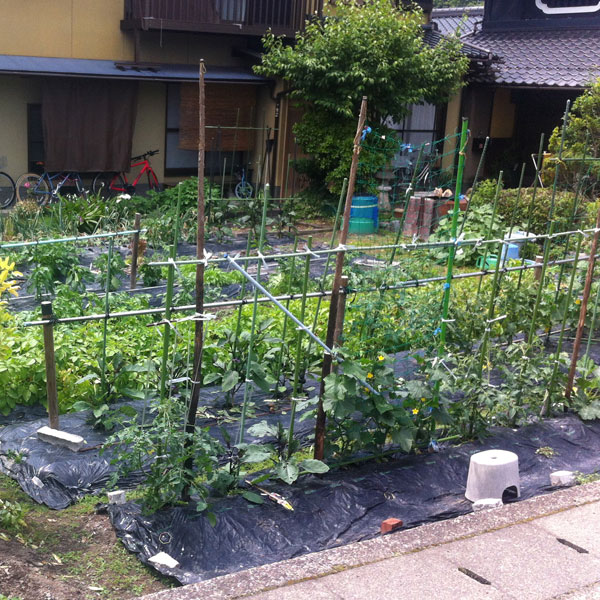
Just about every house has a small vegetable garden. I was surprised to find the same things that I was growing back home, namely: potatoes, broad beans, peas, onions. Eggplant also seems to be a favourite and the pumpkins are starting to show their first leaves. All gardens are very organized and the plants are given plenty of assistance to grow straight or climb with the help of bamboo, metal or wooden sticks and various synthetic lines or ropes for guidance. There appear to be 3 ways of approaching the security of a garden. The first is to ignore it and leave it totally open and without any kind of barrier or protection. The second way is to completely surround, the sides and above, the garden with chicken wire or nets. And the third way is a little more extreme and employs several layers of electric fencing. I am not sure if it is people that are being kept at bay but perhaps and most likely it is the spider monkeys, wild boar and even deer that apparently inhabit the hills nearby. The list of animals keeps growing.

The rice paddies are my favourite part of the landscape and you´ll often see ducks wading in them. There are still some empty flooded fields which means that the rice has just been recently planted and in a nearby field there was still a little pallet of seedlings ready to go. From what I understand come October it will be ready to be harvested. At the end of one of the fields there is a house with a green roof shaped like the ones we saw in Miyama, but this one is not thatched but rather made from metal. Today I found out that it is a Buddhist Temple. On the road that leads to the temple there are posters with snakes. I´ll have to ask someone what they say, if there really are snakes around here too, or if this is just a nice way of the Buddhist Monks to tell you, "Stay away, if you can´t read Japanese". It certainly worked with me.

It has been raining all day. School starts tomorrow. I am very excited.

Thursday, May 26, 2016

Japan, Little Indigo Museum, Miyama.

Japan. A day trip to the Little Indigo Museum in the Heritage listed town of Miyama. I take 5 photos from a distance and my phone dies leaving me with no camera or way of recording anything except with my senses. The whole place was filled with the overwhelming scent of clover flowers, simply delicious.

It was an extraordinary experience, a guided visit of the museum with demonstration of the indigo dye process by none other than Hiroyuki Shindo himself and his lovely assistant son. We also got to visit the museum gallery and Hiroyuki´s vast private collection of indigo dyed fabrics of various techniques and from several parts of of the world. Even though most of what was transmitted was in Japanese, the enthusiasm and love for the craft and maintaining the tradition alive was clearly understood.

Lunch was spent by a small cool stream filled with a myriad of dragon flies and tiny brown frogs. Food was what I could find at the shop that I could sort of understand. Bananas and some snacks. The whole place felt as though it was filled with some spirit that seemed very happy to have us there, revealed in the form of ants that attacked the banana peels in my backpack.

This seems like the beginning of a weird and wonderful adventure. When being shown around the school I was asked to always keep the door shut because otherwise spider monkeys will come inside. I admit I am a little tempted to leave the door open.

Tomorrow, phone charged... more photos to take. Weaving starts next week on monday. Can´t wait.