Thursday, July 21, 2016

Almost home

I finally made it to Orihime´s shrine inside the Imamiya shrine. As you can tell by the massive shuttles, there is another just out of vision to the left, this is a shrine for weavers. I gave Orihime a coin and made her a promise. One thing I don´t undertand is why I have to give her some money and then give her a promise as well. What do I get for my 2 cents?  The Imamiya shrine is also known for the 2 shops that face each other on the approach through the east gate, one is 1000 years old, the other 400. They both serve the same thing, little roasted rice cakes on a skewer with a super sweet syrup and a nice cold tea. I found you need to eat the cakes quite quickly because as they cool they become very chewy. I loved them.

Just around the corner from the shrine is Mr. Komori´s 2nd hand weaving supply shop. He was so distracted with what he was reading he didn´t even notice I was there. Once he did realize I was there, we couldn´t understand a word of what each other was saying. His lovely wife quickly brought us some iced coffee, which was random and very welcome. We somehow managed to understand each other, and after about an hour of pointing at things, making drawings and many gestures, I got a dismantled goko swift and later with the help of Mr. Komori´s daughter, I finally managed to get a kiwaku winder as well. 

Mid week fire crackers to liven things up at the school.

Heaven is a matcha pancake. Or 2, in this case.

Gion festival came and went in a flash. The beautifully decorated floats are displayed the days days preceding the parade and at night the streets come to life with light, food and music. 

A quick visit to Ohara to stock up on shiso juice and jam and to visit Hosen-in temple. The main hall of this temple has as magnificent view to a beautiful garden with a 700 year old matsu that is shaped like mount Fuji. It is a magnificent tree. It is difficult not to admire it an it is said that it is difficult to leave the temple due to the beauty of the gardens. As you admire the tree you are brought tea and a small sweet. There is one detail, however, about the temple that made me feel very sad and the air a little heavy and difficult to breathe. Some of the wooden boards used to make the ceiling of the temple were recycled from Fushimi castle after it was dismantled in 1623. Around the year 1600 upon losing their castle, 380 samurai commited ritual suicide realizing they would otherwise be captured. Their blood stained the floor boards. After many years in storage, these were distributed throughout 7 temples in Kyoto to honor those deceased. You can see a face on one of the boards and other marks that resemble feet, hands. It was just terribly sad. I had to leave after all.

And back to Kasuri an the final stretch home. All tied, all dyed, all set. And now I am finding it difficult to replicate my sample, for the part with the tiny nassen gasuri, not surprising because that is what happens when you use natural dyes. I changed some colours too, replaced cochineal with Indian madder. I can´t wait to see it finished. The weather is just too hot and humid and I am so incredibly tired. But happy. 


Friday, July 8, 2016

Kasuri sampling, parties & fish feeding


It is only now, that we have to create our projects from scratch, that we realize how much we were spoon fed in our last projects. Actually, we couldn´t have got through the amount of work we did otherwise. Two weeks have passed and today I finally managed to get my samples off the loom. 

The design seems simple enough, but there are a lot of calculations to do. And I decided to go with natural dyes which slows everything down even further because of all the preparation of the yarn, pre-mordanting, brewing of plant materials etc. But it is fun hanging out in the dyeing room and trying to communicate with Hori-sensei who is responsible for this department. Yesterday I caught him practicing his golf swing. Apparently you can watch but you must not interrupt and no one thinks this is strange. The not so fun part is the colours not coming out anything like the samples. The only one that really worked was logwood, so I might have to rethink my plant material or my approach. For two of my colours I was actually using cochineal and after those colours not really turning out either I have decided to save money and spare the dead insects.

Before dyeing even became a concern, I spent most of one week binding Kasuri. Then the loom had to be set up as per usual. I am so tired that I can´t imagine having to do all of this again but on a larger scale and getting that all done in just another two weeks. But I am happy with the results, especially with the tiny nassen gasuri.

And to slow things down, all of a sudden we are having parties and getting dressed up in kimonos. Fun!

The first party this week was the Tanabata. In this party we honor the weaving princess, who only on this day the 7th of the 7th month can meet her lover, but only if it does not rain, which it didn´t. It is a sad story. But we get to eat sweets and play games and I won a brass reed sleying hook used to sley very fines yarns like those used for weaving kimonos. Next week we will get to visit one of the floats that will parade in the Gion Festival, also happening this month. So many things to do and so little time.

Last weekend I finally made it to the Golden Pavilion and it was so boring I won´t even bother to show it. On the way back and after much walking I came across a small shrine between Nijo Station and Kyoto City Hall. There was a vending machine, and for 100 yen you got a wafer biscuit filled with pellets to feed the koi fish and turtles and the leftover wafer was for the ducks. Best, most sensible packaging I have found so far in Japan and the best random 100 yen spent.

Sunday, June 26, 2016

Applied Kasuri I- mission completed.


And we have reached the end of the Applied Kasuri I course. This week we attempted Shifting Kasuri. After binding and dyeing the warp the loom was set one more time. We used a Kasuri shifter that is fastened to the back of the loom for the purpose of shifting warp sections desired lengths, always in the same direction. And as per usual after agonizing to get everything to line up perfectly once we started weaving the whole thing just shifted a little more and then a little more and by the end of the piece it all just looked like a big mess. You can till see the arrow shapes but they are just really crazy looking. But I guess that is the beauty of Kasuri, the way it moves and blurs and ends up looking a little chaotic sometimes.

The rice keeps growing.

This weekend there were 2 markets on. On saturday the market was held at the Kitano-Tenmangu Shrine. It was more of a second hand market selling lots of cheap kimonos and fabrics as well as slightly overpriced vintage and antique objects and odd things like live pet beetles. I liked the market but was more impressed by the crazy foods and tried these ball shaped pancaky things with bits of octopus inside as well as a black sesame soft serve to add to the list of great flavours. Today´s market was at the Kamigano-jinja Shrine. It was a large craft market held on the shrine gardens with a small creek running beside it, lovely venue and lots of nice things to buy. I could not resist buying a pair of Pokkuri. First I chose the sole and then the straps and then waited and watched as they were carefully and artfully prepared. Then I tried them on and they were perfectly adjusted to fit my foot. I love them.

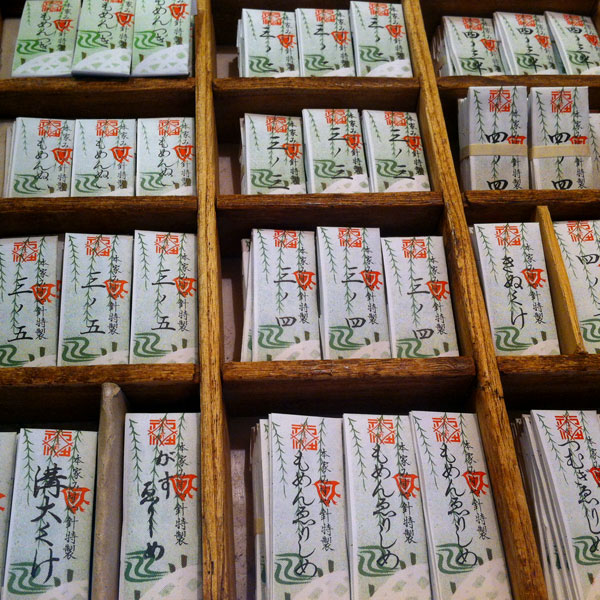
Other weekend activities included buying some needles from the 400 year old needle shop, Misuyabari. I also visited Maruzen, a bookshop famous for featuring in a short story by Kajii Motojiro from 1925 titled "Lemon". You can buy many things lemon at the store these days including a pretty lemon cake. I just photographed it, didn´t really feel like eating. I managed to spend a lot of money on stationery items instead and on a book by Yukio Mishima, titled "The Temple of the Golden Pavilion", which is loosely based on a true story of a novice monk that supposedly suffering from persecution complex and schizophrenia, decides to burn Kinkaku-ji Temple to the ground for being too beautiful. He plans to kill himself in the fire but at the last minute is incapable of staying with the flames and runs to a hill behind the temple and there attempts and fails suicide and so gives himself in to the authorities. He is sentenced to jail for 7 years but is released due to his mental illness and dies 5 years later from tuberculosis. The fire happened in 1950 and the Temple was rebuilt also 5 years later and restored to its former glory, covered with even more of the gold leaf that gives it its name. It is still on my list of Temples to visit.

It is interesting that this young monk burnt the Temple down for it being too beautiful. Japan is a very naturally beautiful place but one cannot forget that is it also highly manicured, as are perhaps the behaviours of people.  There is an inherent spirituality and beauty of this place, that you feel in the water, the rocks and the trees and smell in the very wood that the temples are made from. Even the wind seems magic here, you notice the smallest of things as signs from above that make it easy for you to feel connected to something that is a little more than just you. And it is these very things, that I am loving for not feeling them where I have come from. But somewhere something got lost. It is this very simplicity, beauty and strictness, that apply to every aspect of this culture from the tea ceremony to the flower arrangements and garden design, that have suffocated younger generations wanting to break free from "the forms and disciplines of the Zen Buddhist way of life"* that have led to the loss of value of the spiritual awakening of the individual in his search for enlightenment. I guess it is all about about finding the right balance. I am certainly feeling all these things applied to my learning of Kasuri.

* The Temple of the Golden Pavillion", Yukio Mishima, translated by by Ivan Morris, from the introduction by Nancy Wilson Ross, fist published 1956

Monday, June 20, 2016

Applied Kasuri I- Nassen Gasuri


Last week we began the Applied Kasuri course and the first technique to try was Nassen Gasuri. Nassen Gasuri is essentially a stencil kasuri, where the dye is applied directly to the warp on the loom. The stencils that were used in the past were cut from a paper made from mulberry leaves and smoked with persimmon juice and even though this paper is no longer manufactured there are still some stocks around. Today, a synthetic "paper" is available for the same purpose and lasts probably a little longer too. The back of the stencils are sprayed with glue and stuck to the warp. Acid dyes are applied with short bristled square brushes, and rubbed into the warp. A mixture of dye and meypro gum is made beforehand in small quantities and the right consistency is tested so as to make sure there are no bleeds. Too much meypro gum is not advised because when it dries it becomes very stiff. Before weaving a newly applied stencil it is very important that the dye is dry. A hairdryer is used to speed up the process. And that is it really.

I did not approach this project as an opportunity to improve my stencil cutting skills nor elaborate designs. Seeing as we were literally thrown into the deep end with regards the potential of this technique and had to produce designs before knowing its potential and limitations, I was more interested in learning what could be done and how. My design was very basic and that was ok. It allowed me not to concentrate on layout so much but technique and in the end I came up with a half tone approach that I am very happy with and has lots of potential as it can be used to replicate warp Kasuri. Very clever indeed.

To finish, the woven piece is taken off the loom and ironed, then rolled with interfacing fabric and steamed for 40 minutes. It is then rinsed with a solution, I cannot remember the name of now, to remove the meypro gum and then rinsed with cold water, spun and hung to dry.

To mark the end of this project and to seek some relief from saturday´s hot weather I decided to visit a small village close by called Ohara. It has many temples, I visited the Sanzen-In Temple and admired the beautifully manicured gardens and the hundred of varieties of moss. But the best part of this trip was that I found out that Ohara is famous for pickles and in particular Shiso dyed pickles. Shiso is a plant that belongs to the mint family and has the most amazing colour and flavour ever. To top it off you can get soft serve ice cream flavoured with it and even juice (cordial). I opted for the juice because I had just finished a green tea soft serve and you only have so much of the stuff. You can see above the juice I drank in its natural environment. They call it purple perrilla, I call it red perrila. It also comes in green, and I have seeds!!!!!